


Walk through the gates of any major UK event today and you are walking through a quiet technological revolution. From the simple paper wristband clasped to your wrist at a village festival to the facial recognition systems scanning thousands of fans at a Premier League ground, event access control in Britain has undergone a dramatic transformation.
Why Access Control Is the Backbone of Every Event
For event organisers across the country, whether running an intimate corporate gathering or a 200,000-person music festival, understanding the full spectrum of access control technology is no longer optional. It is central to delivering safe, smooth, and memorable experiences.
Access control is far more than a gateway. It is the first impression an attendee has of your event, and as any experienced organiser knows, you never get a second chance at a first impression. A poorly managed entrance creates queues, frustration, and a sense of disorganisation that colours every experience that follows. Done well, however, access control sets a positive tone, provides a layer of genuine security, and generates valuable data that improves every future event you run.
Starting Simple: Paper Wristbands and Basic Credentials
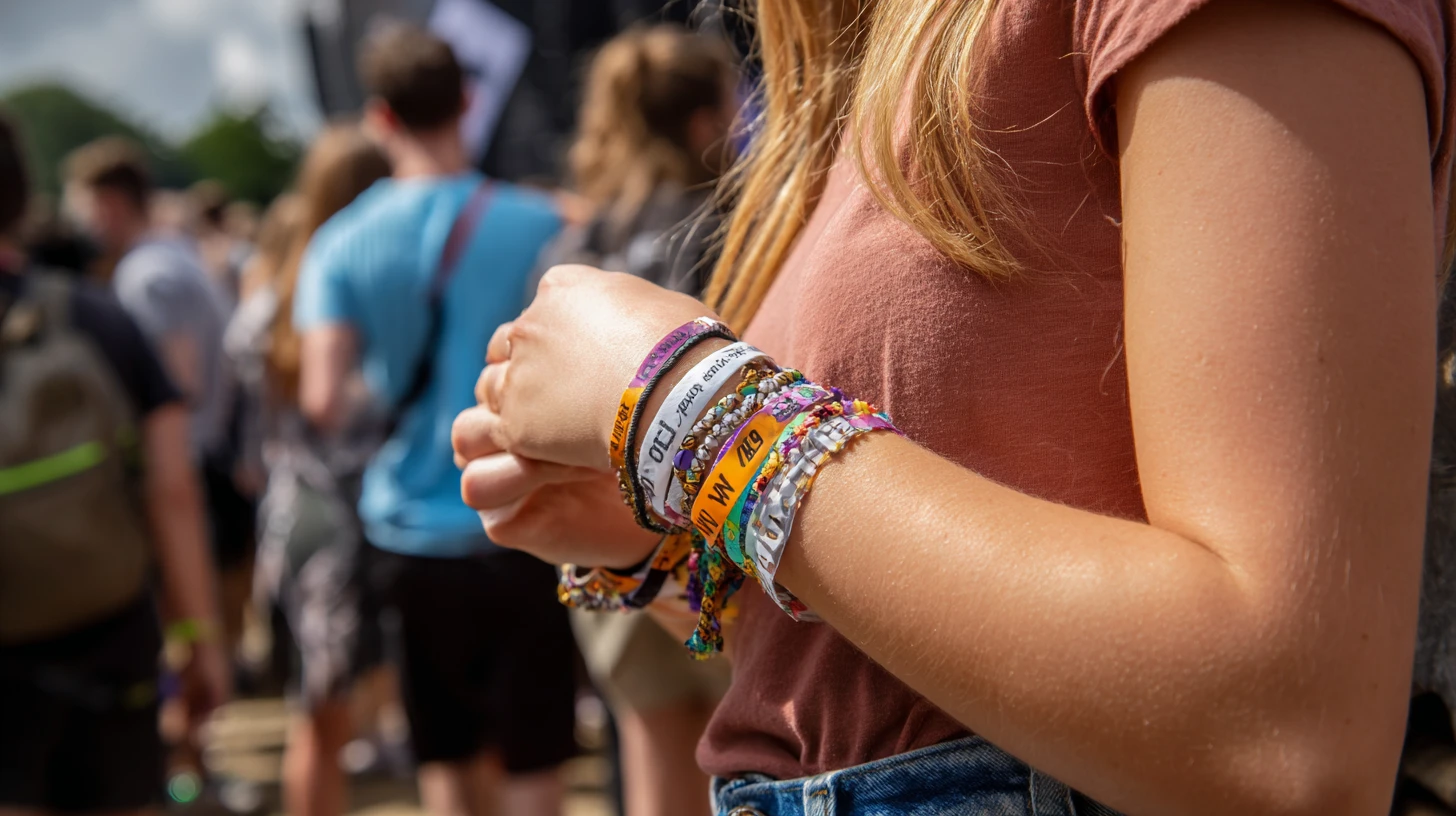
For smaller UK events, such as local music nights, charity fundraisers, private parties, and community festivals, the humble wristband remains the workhorse of access control. Tyvek paper wristbands are cheap, fast to produce, and easy to distribute. A colour-coded system allows door staff to understand at a glance whether a wearer has VIP access, general admission, or is a member of staff, without needing any technology at all.

The Importance of Clear Signage and Colour Coding
However, simplicity comes with trade-offs. Any credential system that relies purely on visual identification demands clear staff training, consistent colour schemes, and strong signage at every access point. When just one person who is not allowed into an area starts to argue because the credential system is unclear, a queue forms, and that is precisely what every organiser wants to avoid.
For this reason, even at smaller events, the best practice is to print wristbands in distinctly different colours or patterns for each access tier, supported by prominent signage at each checkpoint explaining precisely which credentials are required.

The Role of Security Teams and Radio Communications
Alongside physical credentials, effective access control at even small events depends heavily on clear security communications between staff. Two-way radio remains the most reliable tool for teams managing multiple access points across a site. When an issue arises at one gate, the ability to transmit an immediate message to colleagues on the same channel and receive a response in seconds can prevent a non-crucial incident from escalating.
Security teams should agree on clear terminology and codes before the event begins, ensuring that every member of staff is familiar with what each signal means and can respond without confusion.
Keeping Emergency Services in the Loop
For public safety reasons, organisers should also ensure their security communications are compatible with emergency services channels where required, particularly at events drawing large crowds. Knowing that all personnel are on the same channel and that critical information can be relayed quickly across the site is as important as the physical barriers themselves.
Paper tickets, once a staple of UK events, are now increasingly rare. They are easily lost, damaged, or counterfeited, and in an age of digital ticketing, they offer little protection against fraud. For any event expecting more than a few hundred attendees, organisers are well advised to move up the technology ladder.
The Middle Ground: Barcodes, QR Codes, and Mobile Ticketing
For mid-sized UK events, including corporate conferences, theatre performances, and sporting fixtures below the top tier, barcodes and QR codes represent the accessible step up from purely physical credentials. QR codes in particular have become the dominant format, largely because they are faster and more reliable to scan than traditional barcodes, contain built-in error correction, and can be generated instantly through ticketing platforms widely used in the UK market.
Going Digital: The Benefits of QR-Based Entry
QR codes are a fast and simple way to distribute tickets, scan people at the door, and check clearance levels, and they can also help organisers boost sustainability credentials by moving away from paper tickets in favour of digital equivalents. Each QR code is unique, which means it can be used to prevent fraud and implement timed entry schemes, a particularly effective tool for managing crowd flow during busy periods.
Real-Time Data and Staff Coordination
Mobile ticketing, where attendees store their credential on a smartphone and present it at the gate, slots naturally into the QR ecosystem. For UK event organisers, this approach has a further advantage: it integrates with existing registration and event management software, so check-in data feeds directly into analytics dashboards in real time. Organiser teams can monitor which entrances are busiest, identify bottlenecks as they develop, and redirect staff accordingly, all without waiting for a post-event debrief.
Where QR Codes Fall Short
The limitation of both barcodes and QR codes is that they depend on a visual scan. In poor weather, a reliable feature of outdoor UK events, screens can dim, phones can be fumbled, and scanner angles can cause misreads that slow entry to a crawl. They are also vulnerable to screenshotting and duplication if the ticketing system does not actively validate each scan against a live database.
RFID Wristbands: The UK Festival Standard
Radio Frequency Identification, known as RFID, has become the technology of choice for UK music festivals, large outdoor events, and multi-day experiences. RFID wristbands and badges allow for quick scanning and can store attendee information, making them widely used for their efficiency and reliability. An RFID chip embedded in a fabric wristband communicates wirelessly with a reader, meaning attendees simply tap or wave their wrist at a gate sensor and walk through. No fumbling, no screen glare, no paper to protect from the rain.

Faster Entry and Stronger Anti-Fraud Protection
Events using RFID have reported up to 40% faster entry times compared to barcode scanning, particularly during peak gates and re-entry surges. Each wristband carries a unique encrypted code, making duplication nearly impossible, and lost bands can be deactivated instantly. These features address two of the most persistent headaches for UK festival organisers: long entry queues and ticket fraud.
Cashless Payments and Crowd Intelligence
Beyond access, RFID wristbands have transformed the on-site economy. Cashless payment systems built on RFID technology allow festivalgoers to preload funds onto their wristband and spend across food, drink, and merchandise stalls with a single tap. Organisers report 15 to 30% higher on-site spending after switching to RFID payments, a figure that has made the technology financially attractive even accounting for its higher upfront costs compared to simpler credential systems.
Using RFID Data to Improve Future Events
RFID also generates a continuous stream of crowd movement data. Every scan at every gate or zone checkpoint builds a picture of how attendees flow through a site, where bottlenecks form, and which areas are over-staffed or under-staffed. For recurring UK events, this data is invaluable: it allows organisers to redesign layouts, adjust staffing models, and predict peak demand with genuine evidence behind their decisions.

Most RFID providers can even produce live analysis during an event, allowing teams to correct traffic flow issues or call in additional staff to critical points using their radio communications before a problem becomes serious. The UK market for RFID event wristbands is served by a number of specialist suppliers, including ID&C, a British company that has been at the forefront of festival RFID adoption for well over a decade and whose work spans major events across Europe.
NFC: The Smartphone-Friendly Alternative
Near Field Communication, or NFC, operates on similar principles to RFID but enables two-way data exchange at shorter range. This makes it particularly suited to environments where smartphones themselves serve as credentials. An attendee can store an NFC-enabled event pass in their mobile wallet, tap their phone at an entry point, and be verified instantly.
Security Advantages of Short-Range Technology
Shorter-range NFC connections are harder to intercept, making them more secure, which provides attendees peace of mind given that a significant proportion of users express concern about their personal data falling into the wrong hands. For UK corporate conferences and trade shows, NFC badges also enable networking features. Delegates can exchange contact details by tapping their badges together, adding a layer of engagement value that goes well beyond pure access control.
Biometric Access Control: The New Frontier for Large UK Events
At the top of the technology spectrum sits biometric access control, and it is here that the UK events industry is experiencing its most significant and most debated transformation. Facial recognition, fingerprint scanning, and palm-vein identification are increasingly being piloted and deployed at major UK venues and events.

Real-World Deployments Across the UK
Northamptonshire Police implemented live facial recognition technology at the British Grand Prix in July 2023, an event that attracted around 480,000 attendees over two days, using the system to enhance safety and support public safety operations during the high-profile occasion. Meanwhile, self-service biometric entry integrations increased by 66% in 2024, reflecting a growing demand for smarter, more efficient event access solutions at live events across the country.

Speed, Security, and the Fraud Problem
For large UK venues, football stadiums, arenas, and major festival sites, the operational appeal of biometrics is clear. Facial authentication can process an attendee in under a second, with no physical credential required at all. VIP fast-track lanes become genuinely frictionless. Fraud becomes structurally impossible, because a face cannot be transferred the way a ticket or wristband can.

Glastonbury: A British Blueprint for Biometric Thinking
Glastonbury Festival provides an instructive British example of the philosophy underpinning biometric ticketing, even before full facial recognition was introduced. The festival's photo registration platform for ticket buyers, introduced in the mid-2000s, virtually ended scalping by ensuring only the true ticket buyer could gain entry, a low-tech precursor to today's biometric approach.

Legislation Driving Adoption
The deployment of biometric systems at entertainment venues in the UK has also been driven partly by the Labour government's 2024 Terrorism (Protection of Premises) Bill, which seeks to place legal obligations on certain event organisers and venue owners to monitor premises and reduce the risk of terrorist attacks, making biometric surveillance an increasingly important component of broader emergency and public safety planning at large events.
Privacy, Consent, and UK Compliance
However, biometric technology at events sits in genuinely contested territory in the UK. South Wales Police faced legal action over their use of facial recognition, with a court ruling that their practice violated privacy rights, highlighting public concern about data misuse when individuals are not fully informed about how their data is being captured and stored. Various festival communities and campaign groups have raised similar concerns.
What the Law Requires of UK Organisers
For UK event organisers considering biometric systems, compliance with the UK Data Protection Act 2018 and the UK GDPR is non-negotiable. Biometric data is classified as a special category of personal data, attracting the highest standard of protection.
Organisers must obtain explicit, informed consent before collecting facial images, communicate clearly how data will be used and stored, and delete biometric records promptly after the event unless attendees have consented otherwise. Over 40 major festivals have pledged not to use facial recognition after fan outcry, a reminder that public trust must be earned alongside technical capability.

Choosing the Right Technology for Your Event
The right access control system is never simply the most technologically advanced one available. It is the system that best matches the scale, budget, security requirements, and attendee expectations of your specific event. Hiring a professional event security service company can take the complexity out of this decision entirely.
Their industry expertise means they can source the right technology at the most competitive prices, while managing the full setup, integration, and operation of your access control systems on the day, giving you a hassle-free, end-to-end solution so you can focus on everything else your event demands.
Matching Technology to Event Scale
A community festival of 500 people in a Yorkshire market town has fundamentally different needs from a 90,000-capacity Wembley Stadium show. For small events, clearly colour-coded Tyvek wristbands with good signage remain a perfectly valid and cost-effective solution.
For mid-sized events, QR code-based mobile ticketing with a real-time dashboard provides a significant upgrade in security, speed, and data without major infrastructure investment. For large festivals and multi-day events, RFID wristbands with integrated cashless payment have become the recognised British standard, operationally proven, commercially beneficial, and well understood by UK audiences.
Preparing Your Team for Any Scenario
Whatever system you choose, preparing your team is just as critical as the technology itself. Staff should be trained not only on the equipment but on clear communication protocols across the site. Every person at an access point should know how to transmit a message, which channel to use, and how to respond when they hear a call for assistance.
In situations ranging from a lost credential to an imminent danger scenario requiring immediate emergency services involvement, the speed and clarity of your security communications can make all the difference.
Getting the Fundamentals Right
For major venues and flagship events where security is paramount and attendee volumes are in the tens of thousands, biometric systems are moving from pilot programmes into mainstream deployment, provided they are implemented with transparency and genuine respect for attendee privacy.
Whatever level of technology you adopt, the fundamentals remain constant: plan access zones early, invest in staff training, ensure robust contingency systems in case of technical failure, and always design the experience from the attendee's perspective first. In the UK's competitive events landscape, the gate is where your event begins, and getting it right sets the tone for everything that follows.