


Everything event organisers need to know from risk assessment and security planning to regulations, costs and choosing the right provider
Every UK event no matter how intimate or how large, carries risk. A packed concert hall, a corporate awards dinner, a music festival in an open field, or a high-profile product launch all share one thing in common: people. And wherever large numbers of people gather, the need for professional event security is not optional, it is essential.
This Ultimate Event Security Guide
Been written for event organisers, venue managers, and anyone responsible for keeping attendees safe. Whether you are planning your first event or your five hundredth, it covers everything you need to know: what event security is, why it matters, how to build a thorough risk assessment, the step-by-step process of creating a robust event security plan, UK legal requirements, costs, staffing ratios, and how to select the right event security company.
By the end, you will have a clear, comprehensive understanding of event security in the UK and the confidence to plan it correctly.
What Is Event Security?
Event security refers to the measures, personnel, systems and procedures put in place to protect attendees, staff, performers, property and the venue itself during any type of organised gathering. It is a broad discipline that encompasses physical security, crowd management, access control, emergency response, and risk management all working together to create a safe environment.
Professional event security is far more than simply placing security guards at a door. A truly comprehensive security approach involves pre-event planning, a detailed event security plan, coordination with local authorities and emergency services, and ongoing monitoring throughout every event. It is a proactive, intelligence-led discipline that anticipates potential threats before they materialise.
At its core, event security exists to achieve three things: prevent incidents before they occur, respond swiftly and effectively when something does go wrong, and provide attendees with the peace of mind that allows them to enjoy the event without concern for their safety.
Why Professional Event Security Is Essential
The UK has seen a number of high-profile incidents at public events that have reshaped the way the industry thinks about safety. From crowd surges and fire risks to terrorism threats and medical emergencies, every event carries genuine potential risks that can escalate rapidly without proper preparation and trained security personnel on the ground.
There are several compelling reasons why professional event security is non-negotiable for every event organiser in the UK:
Legal Duty of Care:
Under the Health and Safety at Work Act 1974 and the Management of Health and Safety at Work Regulations 1999, event organisers have a legal obligation to ensure the safety of everyone on site. Failure to do so can result in prosecution, fines, and civil liability.
Licence Requirements:
Many events require a licence under the Licensing Act 2003 and licensing authorities typically require evidence of a robust security plan as part of the application process.
Insurance:
Most event insurers will not provide coverage without documented evidence of a comprehensive security plan and professionally licensed security staff on site.
Reputation and Trust:
Guests, sponsors, and partners expect every event to be managed safely. A single security failure can permanently damage an organiser's reputation.
Deterrence:
Visible, professional security guards deter potential bad actors. The physical presence of trained personnel significantly reduces the likelihood of incidents occurring in the first place.
The consequences of underinvestment in event security can be catastrophic not just financially, but in human terms. Professional event security is not a cost; it is an investment in the safety, success and long-term reputation of every event.
Types of Events That Need Security
The type of event you are organising will directly influence the nature, scale and complexity of your security requirements. While every event needs some level of security, the specific risks and challenges vary considerably depending on the event security by event type, size, location and audience profile.

Music Festivals and Concerts
Large outdoor music events and concerts present some of the most complex event security challenges. Large crowds, alcohol consumption, temporary structures, and multiple entry points all contribute to elevated risk. Crowd management techniques must be carefully planned, and security personnel need specialist training in crowd control and emergency procedures.

Corporate Events and Conferences
Corporate events including conferences, product launches, awards ceremonies and AGMs often involve high-profile speakers, VIP guests and sensitive commercial information. Security at corporate events focuses on access control, perimeter security, and the protection of individuals and assets. Guest lists and ID checks are standard.

Sporting Events
From Premier League football matches to local athletic meetings, sporting events attract passionate crowds and can escalate quickly. Major events require extensive security planning, close coordination with police and local authorities, and robust crowd management strategies including designated entry points, stewards and CCTV.

Private Parties and Social Events
Wedding receptions, milestone birthday parties and private celebrations may seem low-risk, but they often involve alcohol, late-night running and a mix of guests who may not all know each other. Even at smaller events, security staff provide peace of mind and can manage unexpected situations professionally.

Exhibitions and Trade Shows
Trade shows and exhibitions combine large numbers of attendees with valuable equipment and goods on display. Physical security, access control and bag checks are common requirements, alongside the management of restricted areas for exhibitors and VIPs.

Political Events and Protests
Political rallies, marches, and protest events carry specific and heightened risks, including the potential for confrontation and, in some cases, terrorism threats. These events require specialist security planning, close liaison with police and emergency services, and highly trained security personnel capable of de-escalating tense situations.

Open-Air and Community Events
Village fetes, outdoor cinema screenings, markets and community festivals all benefit from professional security even when attendance is modest. Open spaces present challenges around perimeter management, and the informal atmosphere of such events can create a false sense of security that leaves organisers unprepared.
What Does an Event Security Team Do?
A professional event security team performs a wide range of functions before, during and after every event. Understanding the full scope of what security personnel do helps event organisers appreciate the value they provide and plan their deployment effectively.
Before the Event
- Conduct or contribute to the initial risk assessment
- Review and advise on the venue layout and event security plan
- Identify access points, entry points, restricted areas and evacuation routes
- Liaise with the venue, local authorities and emergency services
- Brief all security staff on roles, procedures and emergency protocols
- Carry out advance searches and sweep of the venue for potential threats
During the Event
- Monitor all entry points and manage access control
- Conduct ID checks, bag checks, and searches where required
- Manage crowd flow and prevent crowd surges at pinch points
- Monitor CCTV systems and communicate via radio with the wider team
- Identify and manage suspicious behaviour or potential security incidents
- Respond to medical emergencies and coordinate with first aid teams
- Enforce venue rules and manage ejections professionally and lawfully
- Protect VIPs, performers and restricted areas
After the Event
- Oversee safe dispersal of attendees
- Conduct a post-event debrief and incident report
- Review what worked and identify improvements for similar events
- Collect feedback from the venue and event organisers
A great security team is proactive, not reactive. Their goal is to prevent incidents from occurring at all and the best measure of their effectiveness is when an event ends with nothing unusual to report.
Event Security: Range of Specialist Roles
A professional event security operation consists of a wide range of event security roles and personnel. The exact composition of any security team will vary depending on the event size, event type, and specific risks identified in the risk assessment. Below are the key roles you are likely to encounter.
Security Manager / Event Security Coordinator
The security manager oversees the entire security operation. They are responsible for creating and implementing the security plan, briefing security staff, coordinating with venue management, local authorities and emergency services, and making real-time decisions during the event. They should have significant experience and hold appropriate SIA (Security Industry Authority) licensing.
Door Supervisors
Door supervisors are the most visible members of any event security team. They manage the flow of people through entry points, carry out ID checks and bag checks, prevent unauthorised access, and handle conflicts at entry. Under UK law, every door supervisor must hold an SIA Door Supervisor licence.
Stewards
Stewards support the wider security team by guiding crowds, assisting with crowd management, directing attendees to emergency exits, and providing a reassuring, helpful presence throughout the event. Stewards do not need an SIA licence but must hold a valid Level 2 Award in Spectator Safety for regulated sports grounds.
CCTV Operators
At larger events, dedicated CCTV operators monitor camera feeds from a control room, providing real-time intelligence to the security team on the ground. They can identify developing situations before they escalate and direct resources to where they are needed. CCTV operators must hold an SIA CCTV licence.
Search Teams
Dedicated search teams conduct thorough searches of attendees at entry points using hand-held metal detectors, bag checks and, where appropriate, physical search. Well-organised search procedures reduce the risk of prohibited items including weapons and drugs entering the event.
Close Protection Officers
Close protection officers (CPOs) provide personal protection for VIP guests, performers, speakers and executives. They assess potential threats, plan secure routes and transportation, and act as a personal security detail throughout the event. CPOs must hold an SIA Close Protection licence.
First Aid Teams
While not strictly security personnel, first aid staff are an essential part of every event safety team. Their ability to respond to medical emergencies quickly can save lives. A good security plan will always specify the required number and location of first aid teams alongside the security team.
How to Plan Your Event Security (Step by Step)
A strong security plan does not happen by accident it is the result of careful, methodical planning that begins long before the event takes place. Here is a step-by-step guide to building a comprehensive event security plan for any event.

Step 1: Conduct a Thorough Risk Assessment
Every security plan begins with a thorough risk assessment. This involves identifying all potential risks associated with the specific event including the venue, crowd size, event type, likely audience profile, time of day, and any external factors such as local crime rates or political climate.
A thorough risk assessment should consider:
- Fire risks and fire safety requirements
- Crowd surges and crowd control challenges
- Medical emergencies and first aid requirements
- Terrorism and CBRN threats (for major events)
- Alcohol-related incidents
- Unauthorised access and gate-crashing
- Theft and criminal activity
- Extreme weather conditions (for outdoor events)
- Traffic management and safe arrival/departure
A thorough risk assessment is the foundation of every successful security plan. Without one, you are planning blind.
Step 2: Define Your Security Objectives
Based on the risk assessment, define clear security objectives for the event. What does success look like? What are the non-negotiable safety standards you must meet? Security objectives should be specific, measurable and communicated clearly to every member of the security team and event staff.
Step 3: Map the Venue Layout
A detailed understanding of the venue layout is essential. Map all entry points and exit points, identify restricted areas, mark emergency exits and evacuation routes, note the location of fire extinguishers and first aid posts, and plan where assembly points will be located. A venue layout diagram should be included in the security plan and shared with all relevant parties.
Step 4: Calculate Staffing Requirements
Based on your risk assessment and event venue layout, calculate how many event security guards you need and where they should be deployed. As a general rule, most event security companies recommend a ratio of one security guard per 100 to 150 attendees for a general admission event. However, this ratio may need to increase significantly depending on the event type, alcohol availability and assessed risk level.
For a more detailed breakdown of staffing ratios, see the section on 'How Many Security Guards Do I Need?' below.
Step 5: Plan Access Control
Event access control and perimeter security are one of the most critical elements of any security plan. Decide how guests will be admitted through ticket scanning, guest lists, wristbands or ID checks and how restricted areas will be protected. Ensure all access points have adequate security personnel and that the procedures are clearly communicated to event staff.
Step 6: Develop Emergency Procedures
Every security plan must include clear, tested emergency response and incident management for a range of scenarios, including fire, medical emergencies, a major security incident, and full evacuation. Emergency procedures should specify who does what, in what order, and how communication will work between security staff, event staff, emergency services and the venue.
- Designate a command and control point
- Assign specific roles for each emergency scenario
- Ensure all staff know the evacuation routes and assembly points
- Test emergency procedures before the event day
Step 7: Coordinate with Local Authorities and Emergency Services
For any significant event, proactive engagement with local authorities, the police and emergency services is essential. Many local authorities require event organisers to submit a formal security plan for review, and police liaison can provide invaluable intelligence and support. Emergency services need to know the event is taking place, the expected crowd size, and how they will access the site in an emergency.
Step 8: Brief the Full Team
Every member of the security team and event staff must be fully briefed before the event begins. Briefings should cover: roles and responsibilities, access control procedures, emergency procedures, communication protocols, and any specific intelligence or concerns relevant to the specific event.
Step 9: Monitor, Adapt and Review
During the event, the security manager should monitor the situation in real time and be ready to adapt the plan as needed. After the event, a thorough debrief should review what worked, what could be improved, and whether any incidents require formal reporting. Collecting feedback from your security team, event staff and the venue helps you continuously improve your approach to future events.
How Many Security Guards Do I Need for My Event?
One of the most common questions asked by event organisers is: how many security guards do I need? The honest answer is that there is no universal formula the right number of security guards for any event depends on a range of factors that must be assessed individually.

However, the following general rule provides a useful starting point:
General Rule: One security guard per 100 to 150 attendees for a standard indoor event with no alcohol. For events with alcohol, events in open spaces, or high-risk events, plan for one security guard per 50 to 75 attendees.
The following factors will affect how many security guards you need:
| Event Size | Larger events require more security personnel and a more complex security plan. |
| Event Type | High-energy music events and events with alcohol present greater challenges than daytime conferences. |
| Venue Layout | Complex venues with multiple entry points, multiple stages and restricted areas need more coverage. |
| Crowd Size | Higher crowd density increases the risk of crowd surges and requires more active crowd management. |
| Time of Day | Evening and night-time events typically require more security staff than daytime events. |
| Alcohol Availability | Alcohol significantly increases the risk of disruptive behaviour and requires more security guards. |
| VIP Presence | High-profile guests or performers require dedicated close protection and additional security personnel. |
| Local Risk Profile | Events in areas with higher local crime rates or a history of disorder may require additional staffing. |
For major events with 5,000 or more attendees, it is strongly recommended that you work with a professional event security company to conduct a specialist staffing assessment rather than relying on general ratios alone.
UK Regulations Every Event Organiser Must Know
Event regulations & compliance with UK law is not optional. Event organisers who fail to meet their legal obligations face prosecution, fines, licence revocation and, in serious cases, imprisonment. Here are the key regulations governing event security in the UK.

The Licensing Act 2003
Events serving alcohol, featuring live music or entertainment, or providing late-night refreshments require a Premises Licence or a Temporary Event Notice (TEN) from the local authority. Licence conditions will often specify minimum security requirements, including the number of door supervisors required and the hours they must be present. Legal compliance with licence conditions is the responsibility of the event organiser.

The Health and Safety at Work Act 1974
The Health and Safety at Work Act 1974 places a duty of care on event organisers to ensure the health, safety and welfare of everyone on site including attendees, staff, performers and contractors. This requires a risk assessment and appropriate security measures to manage risk effectively.

The Management of Health and Safety at Work Regulations 1999
These regulations require event organisers to carry out a formal risk assessment and implement appropriate control measures. For events involving five or more employees, the risk assessment must be recorded in writing.

The Security Industry Authority (SIA) Licensing
All security guards working at a regulated venue in the UK must hold a valid SIA licence. This applies to door supervisors, CCTV operators, close protection officers and security guards in regulated roles. Hiring unlicensed security personnel is a criminal offence and invalidates your event insurance. Always verify SIA licence status before engaging security staff.

The Regulatory Reform (Fire Safety) Order 2005
This legislation requires event organisers to carry out a fire risk assessment and ensure adequate fire safety measures are in place, including fire extinguishers, fire safety signage, emergency exits, and evacuation plans. Fire safety must be integrated into the wider event security plan.

The Counter-Terrorism and Security Act 2015 (Martyn's Law)
Following the Manchester Arena bombing in 2017, the UK Government has introduced Martyn's Law (the Terrorism (Protection of Premises) Act), which will require venues and events above a certain capacity threshold to have formal counter-terrorism security plans in place. Event organisers should ensure their security plan addresses terrorism threats and that security personnel receive relevant counter-terrorism awareness training.

The Equality Act 2010
Security procedures must be conducted in a way that does not unlawfully discriminate against attendees on the basis of protected characteristics. Search procedures and access control must be applied consistently and respectfully.
Event Security Technology: Tools That Strengthen Your Security Plan
Modern event security increasingly relies on technology to supplement the work of security personnel on the ground. The right event security technology can dramatically improve situational awareness, speed up access control and enhance the overall effectiveness of a security plan.
CCTV and Video Surveillance
A well-designed CCTV system provides security managers with real-time visibility across the entire event site. Modern CCTV platforms with analytic capabilities can automatically flag suspicious behaviour, monitor crowd density and provide evidential footage in the event of an incident. CCTV is particularly valuable for large events and open spaces where physical security guards cannot cover every area simultaneously.
Mobile Devices and Communication Systems
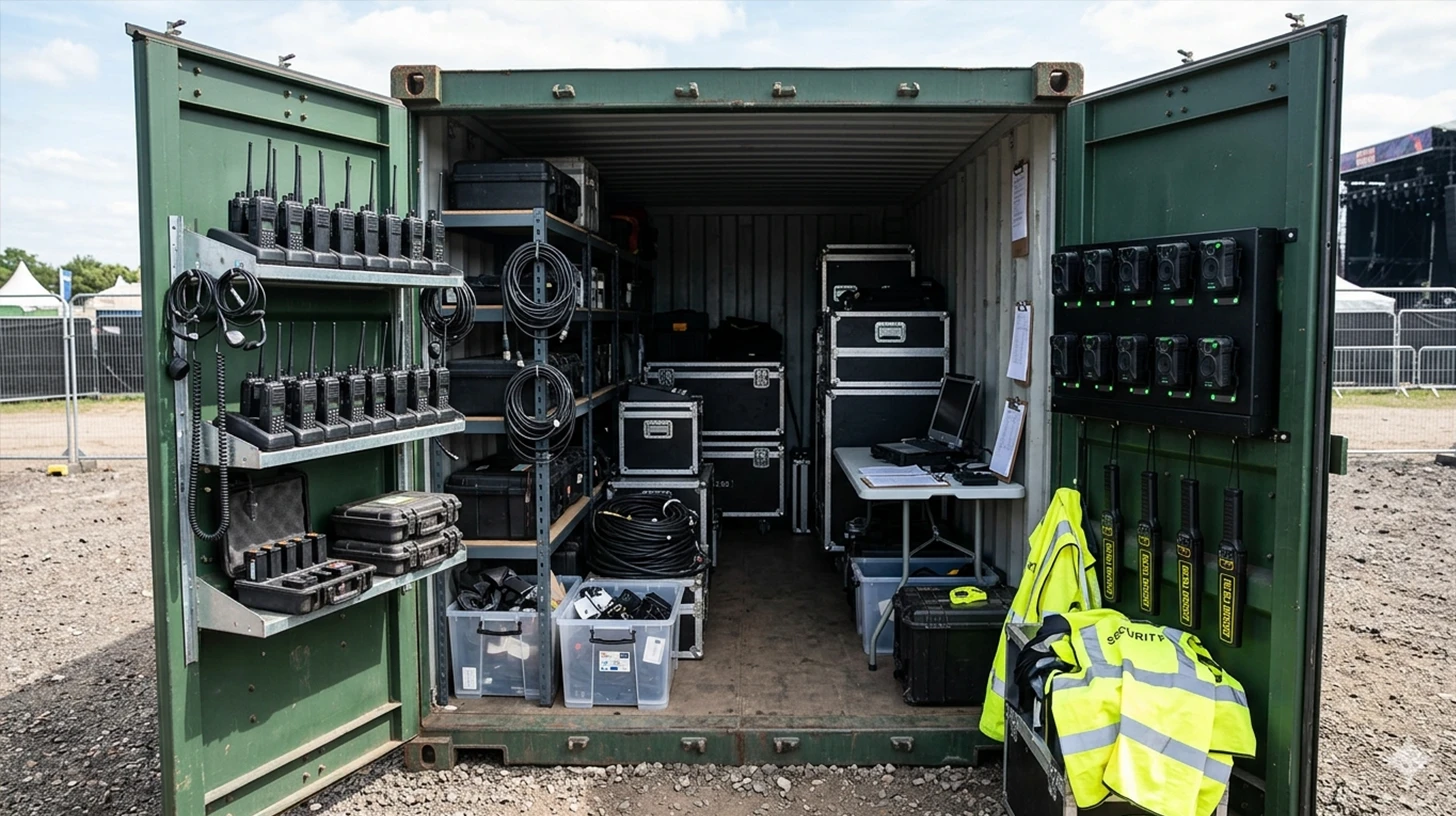
Reliable communication is the backbone of any security operation. Security personnel should be equipped with mobile devices or radio systems that allow instant, clear communication across the entire team. Modern mobile devices can also be used to access guest lists, scan tickets and record incidents in real time, significantly improving the efficiency and accountability of the security operation.
Metal Detectors and Screening Equipment
Walk-through metal detectors and handheld metal detectors are standard security measures at high-risk events and events with specific threat profiles. They form a critical part of the entry point search process, helping to prevent prohibited items including weapons from entering the event.
Ticket Scanning and Access Control Technology
Digital ticketing and barcode/QR scanning systems allow security staff to verify tickets quickly and accurately, significantly reducing the risk of counterfeit tickets and managing access control more effectively. Integration with guest lists allows real-time monitoring of who has entered the venue.
Crowd Monitoring Sensors
At major events, specialist crowd management monitoring technology can track crowd density in real time, providing early warning of developing crowd surges or bottlenecks. This information allows security managers to take preventative action before a situation becomes dangerous by deploying additional security guards to high-pressure areas or opening additional entry points to reduce crowd size pressure.
How Much Does Event Security Cost in the UK?
Event security costs and hiring vary depending on a wide range of factors, including the event size, event type, location, number of security personnel required, duration and the specific services needed. Below is a general guide to event security pricing in the UK.
| Door Supervisors | £18 to £30 per hour per operative (SIA licensed) |
| Security Guards (static) | £16 to £25 per hour per operative |
| CCTV Operators | £17 to £28 per hour per operative |
| Close Protection Officers | £25 to £75+ per hour per operative |
| Event Security Manager | £25 to £60+ per hour |
| Search Teams | Variable typically included in general staffing rates |
| Security Planning / Consultancy | £500 to £5,000+ depending on event complexity |
For a small private event security requiring two door supervisors for 6 hours, you might expect to pay in the region of £240 to £300. For a large outdoor festival with hundreds of security personnel over multiple days, security costs can run into tens or hundreds of thousands of pounds.
It is important to note that cost should never be the primary driver of your security decisions. Cutting corners on security to reduce costs is a false economy the financial, legal and human cost of a security failure far exceeds any savings made. Always seek multiple quotes and compare the experience, accreditations and reputation of potential providers, not just the price.
Always ask event security companies for their SIA Approved Contractor Scheme (ACS) accreditation this is the industry-recognised quality standard for security providers in the UK.
How to Choose the Right Event Security Company
Selecting the right event security company is one of the most important decisions you will make as an event organiser. The wrong choice can leave your event exposed to serious risk. Here is what to look for:
SIA Approved Contractor Scheme (ACS) Accreditation
The SIA ACS is the gold standard for security companies in the UK. ACS-approved companies have been independently assessed against a rigorous set of quality standards covering staff vetting, training, supervision and operational procedures. Always choose an ACS-accredited provider for your event security needs.
Relevant Experience
Ask the company for evidence of experience with similar events in terms of event type, event size and complexity. A company that has successfully managed security for large outdoor festivals or high-profile corporate events will bring invaluable knowledge and insight to your event planning.
Fully Licensed Personnel
Every member of the security team must hold a current, valid SIA licence for their designated role. Ask the company to confirm how they verify and manage licence status across their workforce, and request a copy of relevant licences for all personnel deployed to your event.
Comprehensive Insurance
Your event security company should hold adequate public liability insurance (typically £5 million minimum) and employer's liability insurance. Request certificates of insurance and verify that coverage extends to your specific event.
Clear Communication and Professionalism
The way a security company communicates with you during the procurement process tells you a great deal about how they will operate on the day. Look for clear, responsive communication, a willingness to understand your specific needs and a professional approach to every interaction.
Detailed Written Proposals
A reputable event security company will provide a detailed written proposal that outlines their staffing plan, roles and responsibilities, communication protocols, emergency procedures, and the specific security measures they will implement for your event. Be wary of companies that provide only a headcount and a price.
References and Testimonials
Ask for references from previous event clients and follow them up. A company with a strong track record of delivering successful, incident-free events will be happy to provide them. Online reviews and testimonials can also provide useful insight into the company's reputation.
Event Security Best Practices for UK Organisers
Beyond the fundamentals of planning, regulation and staffing, experienced event organisers know that the difference between a good security operation and a great one lies in the details. Here are some best practices drawn from years of professional experience:
Start planning early: Security planning should begin as soon as the event is confirmed, not in the week before it takes place. The more time you have, the more thorough your risk assessment and event security plan can be.
Involve security professionals in the venue walk: Always conduct a site visit with your event security team before the event. Walking the space together identifies issues that are invisible on a floor plan poor sight lines, inadequate emergency exits, and vulnerable access points.
Use clear signage: Clear signage directing attendees to entry points, emergency exits, first aid posts and assembly points is one of the most cost-effective security measures you can implement. It reduces confusion in an emergency and supports smooth crowd management throughout the event.

Integrate first aid into the security plan: Security and first aid teams must be coordinated. Security personnel are often first on the scene of medical emergencies and need to know how to support first aid response and access to the patient.
Plan for different scenarios: Your security plan should not just cover the expected; it should plan for the unexpected. What happens if the fire alarm activates? What if a VIP guest requires emergency evacuation? What if a large group attempts to force entry? Every scenario should have a pre-planned response.
Reduce risk through good design: Many potential security risks can be designed out at the planning stage. Thoughtful venue layout, clearly marked restricted areas, well-lit entry points and logical queue management all reduce the burden on security personnel on the day.
Debrief after every event: The post-event debrief is where security professionals learn and improve. Reviewing what worked, what did not, and what would be done differently builds institutional knowledge that makes every subsequent event safer.
Final Thoughts on Event Security
Event security is not a box to be ticked it is a genuine, multi-faceted discipline that requires careful planning, qualified professionals, robust procedures, and a commitment to continuous improvement. Every event is different, and every security plan must be tailored to the specific risks and circumstances of the event it is designed to protect.
Whether you are organising an intimate corporate dinner for 50 guests or a major outdoor festival for 50,000, the principles remain the same: conduct a thorough risk assessment, build a comprehensive security plan, engage licensed and experienced security personnel, comply with UK regulations, and never allow cost to override safety.
At Imperial Security, we provide professional event security services across the UK for events of all types and sizes. Our SIA-licensed security teams bring experience, professionalism and meticulous planning to every event, giving event organisers the peace of mind to focus on creating an outstanding experience for their guests.
To discuss your London event security or UK requirements, get in touch with our team today for a no-obligation consultation and quote.
Frequently Asked Questions About Event Security
Do I legally need security at my event in the UK?
This depends on the nature of your event. Events that serve alcohol, feature live entertainment, or take place at a licensed venue will typically require licensed door supervisors under the conditions of the venue's Premises Licence. Even for events without a formal licensing requirement, all event organisers have a legal duty of care under the Health and Safety at Work Act 1974 to ensure the safety of attendees. Professional security is almost always advisable.
What SIA licence does an event security guard need?
The type of SIA licence required depends on the role. Door supervisors need an SIA Door Supervisor licence; CCTV operators need an SIA CCTV licence; close protection officers need an SIA Close Protection licence. Stewards at sports grounds must hold a Level 2 Award in Spectator Safety. All licences should be current and verifiable on the SIA's public licence register.
How many security guards do I need for a 500-person event?
As a general rule, a 500-person indoor event without alcohol would typically require a minimum of four to six door supervisors plus a security manager. For an event with alcohol or in an outdoor setting, you should plan for eight to ten security guards or more. A professional event security company will be able to provide a precise recommendation based on a site visit and thorough risk assessment.
What should a security plan include?
A comprehensive security plan should include: a risk assessment, staffing structure and roles, a venue layout with access points and emergency exits marked, access control procedures (including ID checks and bag checks), emergency procedures (including evacuation plans and assembly points), communication protocols, coordination arrangements with local authorities and emergency services, and a post-event review process.
How far in advance should I book event security?
For larger events, you should begin engaging with event security companies at least three to six months before the event date. This allows sufficient time for site visits, thorough planning, staffing and any necessary engagement with local authorities. For smaller events, eight to twelve weeks is generally sufficient, though peak periods (particularly summer festival season) may require earlier booking.
What is the difference between a steward and a security guard?
Stewards are primarily there to guide, assist and inform attendees they are not legally empowered to carry out the same functions as licensed security guards. SIA-licensed door supervisors have legal powers to refuse entry, search attendees (with their consent) and detain individuals pending police arrival. For most events in the UK, a combination of both stewards and licensed door supervisors is recommended.
What is the SIA Approved Contractor Scheme?
The SIA Approved Contractor Scheme (ACS) is a voluntary quality assurance scheme for security companies in the UK, assessed and administered by the Security Industry Authority. ACS accreditation demonstrates that a security company meets high standards of staff vetting, training, management and operational performance. It is widely regarded as the benchmark for quality in the UK security industry, and many public sector and corporate clients require ACS accreditation as a minimum.
What are the most common security risks at events?
The most common potential security risks at events include: unauthorised access, theft and pickpocketing, alcohol-related disorder, crowd surges and crowd control incidents, medical emergencies, fire, and in higher-risk environments, terrorism and the introduction of prohibited items. A thorough risk assessment will identify which potential risks are most relevant to your specific event and allow you to plan appropriate security measures accordingly.