


Security at UK events is a professional discipline shaped by law, regulation, and hard-won experience. Yet one aspect that consistently separates a competent security operation from a truly professional one is the quality of its written documentation. For any event security team operating in the United Kingdom, thorough, structured reporting is not optional. It is a legal and operational necessity that runs through every phase of an event before the doors open, while they are open, and long after the final guest has left.
Why Written Reporting Matters in UK Event Security
The Legal Foundation
Event security incident reporting is not simply a formality or an administrative burden. It is a formal document that can be reviewed by clients, venue managers, police, insurers, legal teams, and regulatory authorities. Under the Health and Safety at Work Act 1974 and the Management of Health and Safety at Work Regulations 1999, event organisers carry a legal duty of care to everyone on site, and properly maintained documentation is central to demonstrating that duty has been fulfilled.

SIA Licensing and Professional Standards
All security personnel working in regulated event security roles must hold a valid Security Industry Authority (SIA) licence. Door supervisors, CCTV operators, and close protection officers each require their respective SIA-issued credentials. This professional framework, which governs the entire private security industry in the UK, means that when something goes wrong at an event, written records are scrutinised against professional standards. Vague or incomplete documentation can expose the security company, the venue, and the event organisers to serious liability.
The Purpose of a Reporting System
The Arts Council England's guidance on reporting and recording security incidents makes clear that a good reporting and recording system provides a consistent mechanism for capturing incidents, raises awareness among all security staff, enables action to prevent reoccurrence, assists with investigations, and contributes over time to risk assessments and decisions on security resourcing. These principles apply equally across music festivals, corporate events, sporting occasions, and any other public-facing gathering.
Before the Event: Pre-Event Documentation
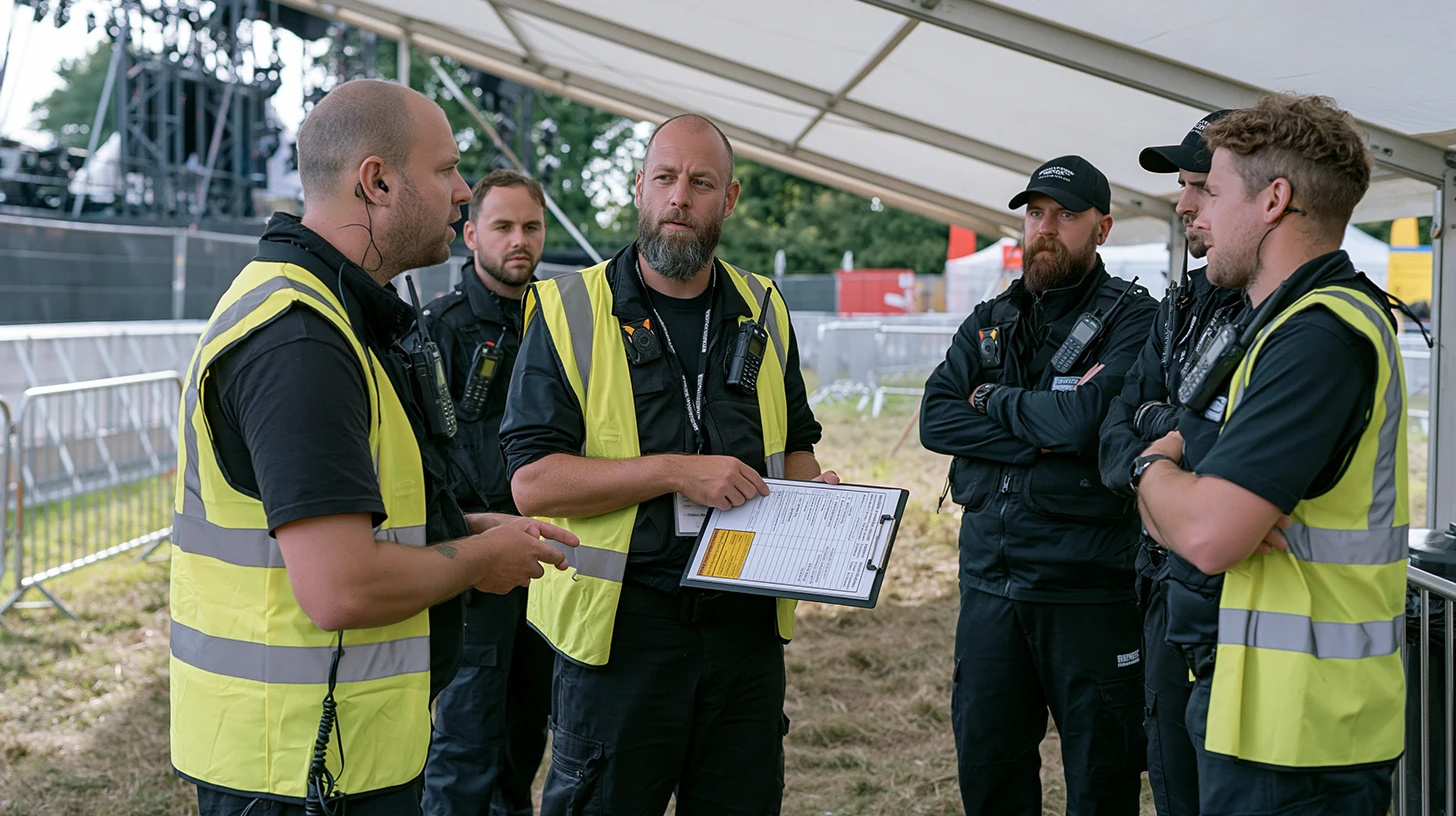
Strong reporting culture begins before a single attendee arrives. A professional event security team should produce and maintain a set of pre-event documents that establish the framework for all decisions made on the day.
The Security Plan
The security plan is the foundational document. It should record the event type, expected attendance, venue layout, identified risks and threat levels, access control procedures, communication channels, and the specific roles and responsibilities of every member of the security team.
The security manager, who oversees the entire security operation, is responsible for creating and signing off this plan. For larger events, this plan will also detail how security guards are positioned across entry points, exit points, and high-risk areas throughout the venue.
Risk Assessment
Closely linked to the security plan is the risk assessment, a legal obligation under UK law. This document records identified hazards, the likelihood and severity of each, and the controls in place to manage them. Risk assessments should cover crowd control, crowd density at entry and exit points, prohibited items, potential threats and the potential for disorder, fire alarm procedures, emergency exits, and any specific security concerns relevant to the event.
Counter-terrorism considerations must also be addressed. Following the Manchester Arena bombing in 2017, the UK Government introduced Martyn's Law, placing new legal obligations on venues and events above certain capacity thresholds to have formal counter-terrorism security plans in place.

Staff Briefing Records
Pre-event documentation should also include a staff briefing record. Every security officer, security guard, and steward on site must be briefed before the event begins. This briefing should cover their specific duties, communication procedures, escalation protocols, and emergency procedures. A written record confirming who was briefed, when, and on what content creates an important audit trail and helps ensure compliance with both UK regulations and the event's own security plan.
Site Inspection Checklist
A site inspection checklist should be completed immediately prior to the event opening. Safety inspections should be carried out before, during, and after the event. The pre-event inspection should note any defects, obstructions, or safety concerns identified during the walkthrough, along with what remedial action was taken and by whom. Valuable equipment including CCTV systems, security equipment, communication devices, and access control technology should all be checked and logged as operational.
During the Event: Live Reporting and Incident Documentation
Once an event is underway, real-time documentation becomes critical. The security team should operate with a clear understanding that anything requiring a response, or that could be reviewed later, must be recorded promptly and accurately.

When to Write an Incident Report
The security guard incident report is the primary written tool of any event security operation. Every member of the security team should know when to write one. A report is required whenever an incident poses a risk to safety, property, or operations; requires the security officer to take action; or could be reviewed by management, a client, or relevant parties at a later date.

Documenting Minor Incidents
Minor incidents such as unauthorised entry attempts, suspicious activity, property damage, or verbal altercations may all be reportable depending on the event's security plan. Even events with no major incident should be documented, as a clean record is itself valuable evidence of a well-run operation.

What an Incident Report Must Include
A well-structured security incident report should follow a clear chronological format. It must include the time and date the incident occurred, the exact location within the venue, a detailed description of what took place, the names or descriptions of the involved parties, the actions taken by the responding security officer, who was informed, any witnesses present, and references to any CCTV footage or physical evidence collected.

Categorising the Incident and Recording
Incident reports should also categorise the nature of the security incident, whether it involves unauthorised entry, theft, vandalism, assault or threat, harassment, medical emergencies, or other criminal behaviour. Where the incident has been reported to local authorities or emergency services, the report should note this along with any crime or reference numbers.

Factual, Neutral Language
Language throughout any incident report must remain strictly factual and neutral. The distinction matters: writing "At 21:30, the person raised their voice and stepped forward" is professional and accurate, whereas writing "the person became threatening" is an interpretation, not an observation. Opinions, assumptions, emotional language, and unverified details have no place in a security report. Security professionals are not there to draw conclusions but to document, clearly and objectively, what they observed.

Documenting Officer Actions
The incident report should also record the security officer's own actions plainly and in sequence, covering what they did, who they informed, what procedures were followed, and what the outcome was. This protects the officer, demonstrates professional conduct, and creates a clear account for any subsequent internal reviews or legal proceedings.

The Duty Log and Control Room Record
In addition to individual incident reports, larger events should maintain a duty log or control room log throughout the event. This is a running record of radio communications, notable observations, arrivals and departures of key personnel, and any decisions made by the security manager. The security manager is responsible for coordinating with venue management, local authorities, and emergency services in real time, and the duty log captures that decision-making as it happens.

CCTV Monitoring Records
CCTV operators, who must hold an SIA CCTV licence, should maintain a monitoring log recording when cameras were checked, any footage flagged for review, any instances of suspicious activity observed, and any periods where camera coverage was unavailable. The ability to monitor crowd density in real time and flag developing situations before they escalate is one of the most critical elements of a large-scale event security operation, and the written record of what was observed is equally important.
After the Event: Post-Event Reporting and Review
The security team's documentation obligations do not end when the last guest leaves. Post-event reporting consolidates the written record of everything that occurred and establishes the groundwork for continuous improvement.

The Post-Event Debrief
A post-event debrief should be completed by the security manager, summarising the overall security operation. This document should note how many security guards and security staff were deployed, any incidents that occurred and how they were handled, whether the security plan was followed, any deviations and the reasons for them, and the overall assessment of how the event was managed. The debrief is also the appropriate place to record follow-up actions, detailing who is responsible for each action and by what deadline.
Reviewing and Filing Incident Reports
Each security incident report written during the event should be reviewed, countersigned by the security manager or a supervisor, and filed securely. All reports must be written in plain English, avoid abbreviations and acronyms, and be accessible to anyone who was not present at the event. The report author must be clearly identified, whether through a physical signature or a digital equivalent, to ensure full accountability. The event details recorded across all documentation should be consistent, accurate, and complete.
Lessons Learned
Post-event, the security team should prepare a lessons-learned summary covering what worked well, what could be improved, and any preventive measures recommended to avoid similar incidents at future events. This document feeds directly into the risk assessment for subsequent events and builds the institutional knowledge of the security operation over time. Strong risk management depends on this cycle of documentation, review, and refinement.

Record Retention and Legal Compliance
All documentation, from the pre-event risk assessment and briefing records through to the incident reports and post-event debrief, should be retained and stored securely. Reports may be used weeks or months later in legal proceedings, insurance claims, audits, or police investigations.
Under professional standards and frameworks including ISO 9001, retaining these records as part of a quality management system supports both legal compliance and ongoing operational improvement. Hiring unlicensed security staff, it should be noted, is a criminal offence under UK law and immediately invalidates event insurance, which makes pre-event documentation of SIA licence verification another essential part of the written record.
The Standard All UK Event Security Teams Should Meet
Reporting as a Professional Obligation
Effective written reporting across all three stages of an event is what separates professional security operations from those that simply show up. The quality of a security guard incident report written at 23:00 after a difficult shift reflects directly on the officer who wrote it, the company they represent, and the client who engaged them.
Training and Consistency
Every member of a UK event security team, regardless of their role, should be trained to recognise reportable incidents, complete structured reports promptly and accurately, and understand how those reports will be used. Security professionals should also understand their role in helping to create a safe environment for all attendees.
As the Arts Council England's guidance makes clear, all security staff should receive periodic training in recognising incidents, completing reports, and understanding what to do when a security incident occurs.
The Bigger Picture
Documentation that is clear, factual, well-structured, and properly retained is not bureaucracy for its own sake. It is the written foundation of professional event security. Whether the event is a music festival drawing tens of thousands or a corporate event hosting a few hundred guests, the same principles apply. Report incidents accurately. Record actions clearly. Review and retain everything. That is what it means to run a professional security operation in the United Kingdom.